The Workplace Data Problem: Why Your Office Needs a Spatial Data Layer
Every modern workspace decision — from cleaning schedules to portfolio optimization — depends on knowing where and when people use space. This sounds simple. The data, after all, seems abundant: access control logs, Wi-Fi connection records, booking system entries, even badge swipes.
So why do most organizations still struggle to answer basic questions about their own buildings? Because the data they have was never designed to describe space.

The “Good Enough” Data Trap
The appeal of existing data sources is obvious. Access systems record every badge swipe. Wi-Fi tracks connected devices. Booking platforms know when rooms are scheduled. But these sources share a fundamental limitation: they describe people, devices, or permissions — not space itself.
Consider what happens when you ask specific questions: “Which zones were actually used today?” Access logs tell you who entered the building, not which areas they spent time in. “Which desks are free right now?” Booking systems show what was reserved — not what’s actually occupied. Walk-ins, no-shows, and early departures create a gap. “Was that meeting room used by only one person?” Calendar data says it was reserved for eight. Only occupancy data from sensors can tell you the truth.
When Data Merging Makes Things Worse
The natural instinct is to merge these datasets. In practice, the merger creates a fragile system. Conflicting schemas: HVAC systems operate in “zones,” booking apps track “rooms,” security logs reference “doors.” Incompatible time resolution: One system updates every second, another every fifteen minutes. Distributed ownership: Access data belongs to Security, Wi-Fi to IT, booking to Workplace Services. No single team owns the full spatial picture.

The Spatial Data Layer: Purpose-Built for Space
The alternative is to stop trying to make non-spatial data do spatial work. Instead, deploy a purpose-built sensing layer designed from the ground up to describe space.
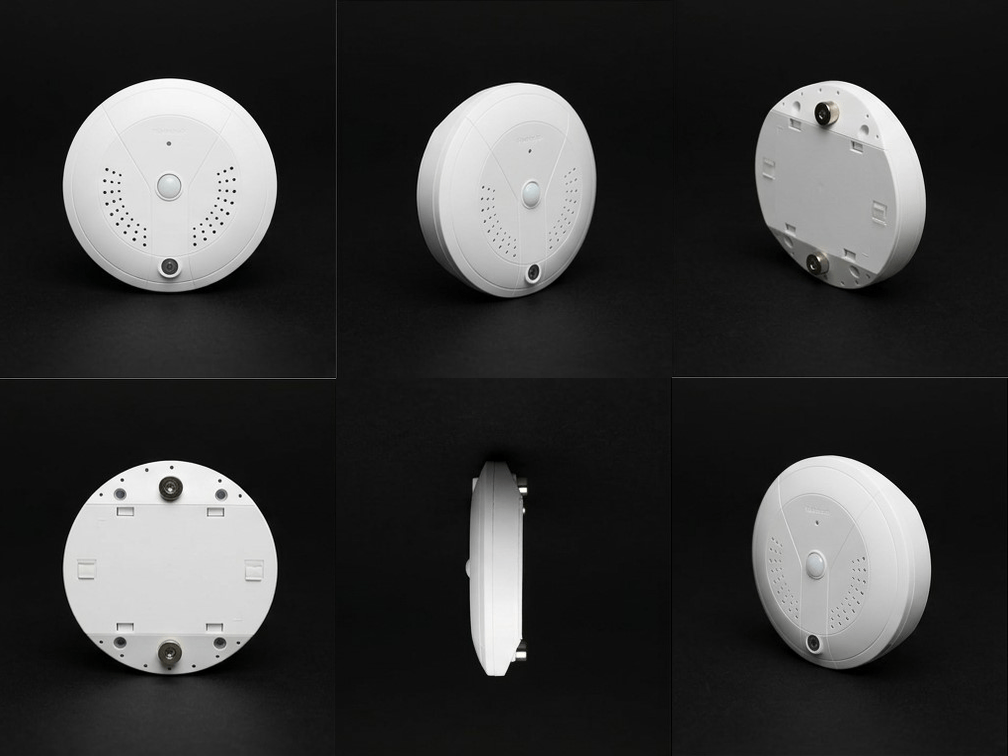
A spatial data layer sits physically in the building. Crucially, these are ceiling-mounted sensors. Unlike wall-mounted alternatives or horizontal Wi-Fi scanning that suffer from blind spots and occlusion, a top-down perspective provides an unobstructed, true-spatial view of how space is used in real time.
Furthermore, enterprise environments demand reliability without choking existing IT infrastructure. Modern spatial layers utilize robust, high-density mesh networks—like the Thread network protocol—to ensure continuous, secure data transmission, far outperforming the bandwidth limitations of older protocols like LoRaWAN.
This approach produces a single, consistent data stream with three properties the improvised approach can never match:
- Spatial precision. The data is anchored to physical locations: specific desks, zones, rooms, and areas. It doesn’t need to be reverse engineered from badge swipes or device connections.
- Temporal consistency. Every sensor reports at the same cadence—continuous real-time monitoring rather than event-triggered snapshots. There’s no interpolation gap between a badge tap at 9am and a Wi-Fi disconnect at 5pm.
- Universal schema. One naming convention, one coordinate system, one API. Whether the question comes from Facilities (cleaning), Workplace (booking), IT (space planning), or Finance (cost optimization), they all query the same data layer.
What a Spatial Data Layer Enables
With a consistent, purpose-built data foundation, workspace applications move from guesswork to evidence. More importantly, this reliable data stream serves as the foundation for Agentic AI in facility management. It allows intelligent agents to move beyond passive dashboards and instead actively manage the building as a service.
- Demand-based cleaning. Cleaning crews follow actual usage patterns—not fixed schedules. Restrooms, kitchens, and desk zones get cleaned when data shows they’ve been used, reducing waste and improving hygiene where it matters.
- Dynamic space allocation. Floor plans evolve based on measured demand. If sensor data shows desk zones at 40% utilization while collaboration spaces overflow, the data makes the case for rebalancing—backed by months of evidence, not a single walkthrough.
- Accurate space utilization benchmarking. Compare buildings, floors, and zones on a like-for-like basis using the same measurement methodology everywhere. No more debates about whether Wi-Fi counts or badge data is a better proxy.
- Autonomous workspace management. When sensors feed real-time occupancy into the ecosystem, the platform does more than just auto-release no-show reservations. AI agents can dynamically guide employees to available space, autonomously negotiate space allocation, and adjust HVAC based on real-time density—without human micromanagement.

Getting from Here to There
The good news: deploying a spatial data layer doesn’t require replacing existing systems. PointGrab’s family of CogniPoint (wired and wireless) occupancy sensors sit on the ceiling and deliver data through standard REST APIs. Crucially, these sensors utilize powerful edge-AI processing. This guarantees absolute spatial precision while maintaining strict privacy-by-design—no images are ever stored or transmitted, directly answering the core privacy anxieties of Security and IT teams.
They integrate perfectly with the booking, BMS, and analytics platforms already in place—but they replace the fragile data merger with a clean, reliable, purpose-built source of truth.
The first step is a pilot on one or two floors. Within 30 days, you’ll have a utilization baseline that’s more accurate than anything built from badge, Wi-Fi, or booking data. From there, the spatial data layer scales across the portfolio.
Ready to learn more? Contact PointGrab for a consultation.
Once the spatial data layer is in place, the next step is ensuring it stays software-agnostic — so data flows freely to any platform without vendor lock-in. See also how an application-agnostic occupancy data layer puts this into practice.
Frequently Asked Questions
What is the workplace data problem?
The workplace data problem refers to the disconnect between what organizations assume about office utilization and what actually happens, leading to poor real estate decisions.
Why is occupancy data important for workplace decisions?
Occupancy data provides factual insights into how spaces are actually being used, allowing organizations to make informed decisions about real estate, design, and resource allocation.
How do companies lose money without occupancy data?
Without accurate usage data, organizations may maintain expensive office space that’s underutilized, overinvest in amenities that aren’t used, or miss opportunities to optimize layouts.
What metrics matter most for workplace management?
Key metrics include desk utilization rate, meeting room occupancy, peak occupancy times, and space efficiency ratios that help justify real estate investments.
Can surveys replace occupancy sensors?
Employee surveys provide subjective feedback but lack the precision of sensor data. A combination of both offers the most complete picture of workplace usage.
How long does it take to see ROI from occupancy data?
Most organizations see significant insights within 30-60 days of deploying sensors, with financial benefits realized within 6-12 months through optimized space allocation.
Related Articles
- The Complete Guide to Occupancy Sensors for Modern Offices
- Desk Occupancy Sensors: The Case for Workstation Monitoring in Hybrid Offices
- Meeting Room Abuse: How the WASH Index Exposes Hidden Space Waste
- Building an Application-Agnostic Occupancy Data Layer
- Why Software-Agnostic Occupancy Data Matters: Avoiding Vendor Lock-In