Demand-Based Cleaning: How Occupancy Data Is Transforming Facility Maintenance
Commercial cleaning is one of the largest operational expenses in office management, typically costing $2-4 per square foot annually. Yet most cleaning schedules are fixed — every floor, every restroom, every kitchen area gets cleaned on the same schedule regardless of whether anyone used it that day.
In a hybrid environment where daily occupancy wildly fluctuates between 30% and 80%, this traditional model is no longer just inefficient; it is a massive, unchecked drain on operational budgets. You are essentially paying to clean empty air. Demand-based cleaning, driven by secure, real-time spatial telemetry, changes this equation entirely — transforming a static overhead cost into an agile, data-driven workflow.
The Problem with Fixed Cleaning Schedules
Traditional cleaning operates on a simple model: clean everything, every night, on a fixed schedule. This made sense when offices were full five days a week. In a hybrid world, it creates two problems simultaneously.
Over-cleaning empty spaces wastes money. If the third floor had 20% occupancy on Tuesday, it does not need the same cleaning as Monday when it was 85% full. Every unnecessary cleaning cycle costs labor, supplies, and energy. Under-cleaning busy areas creates poor experiences. The busiest restrooms, kitchens, and meeting rooms may need mid-day attention that a fixed schedule does not provide.
How Occupancy Data Enables Demand-Based Cleaning
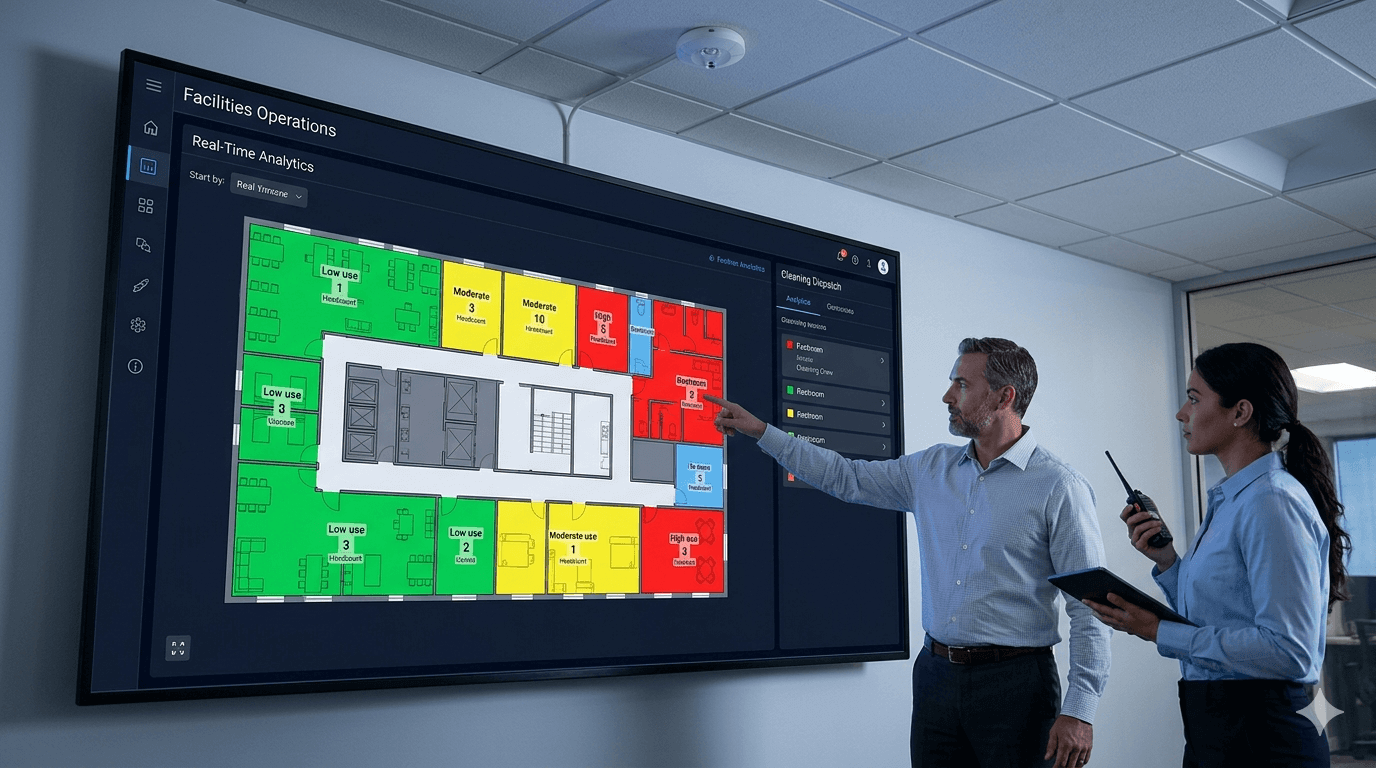
With real-time occupancy data, facility teams can make cleaning responsive to actual usage. The logic is straightforward: rooms and zones with higher traffic get more cleaning attention; spaces with little or no usage get lighter or deferred cleaning.
Zone prioritization: At the end of each day, occupancy data shows which zones had the highest traffic. Cleaning crews can prioritize high-use areas and reduce time spent on low-use zones. Restroom and kitchen triggers: Occupancy sensors near high-traffic amenity spaces can trigger cleaning alerts when usage crosses thresholds. Instead of cleaning restrooms every two hours regardless, cleaning happens when the restroom has actually been used by a certain number of people. Floor-level scheduling: If an entire floor had less than 25% occupancy, the cleaning can be reduced to light touch-up rather than full service. This data can automatically adjust the next day’s cleaning schedule.
Quantified Savings
Organizations implementing demand-based cleaning typically see 20-30% reduction in cleaning costs while maintaining or improving cleanliness scores in high-traffic areas. For a 500,000 square foot office, that translates to $200,000-$600,000 in annual savings.
One major financial services firm using occupancy-driven cleaning reported $2M in annual savings by automating their cleaning dispatch based on real-time sensor data. The key was not cleaning less overall, but cleaning smarter — more attention where needed, less where it was not.

Sensor Requirements for Cleaning Optimization
Effective demand-based cleaning requires sensors that can provide zone-level traffic data (not just room presence), real-time updates (for mid-day cleaning triggers), and historical patterns (for predictive scheduling). The data needs to integrate with cleaning management platforms or building operations systems.
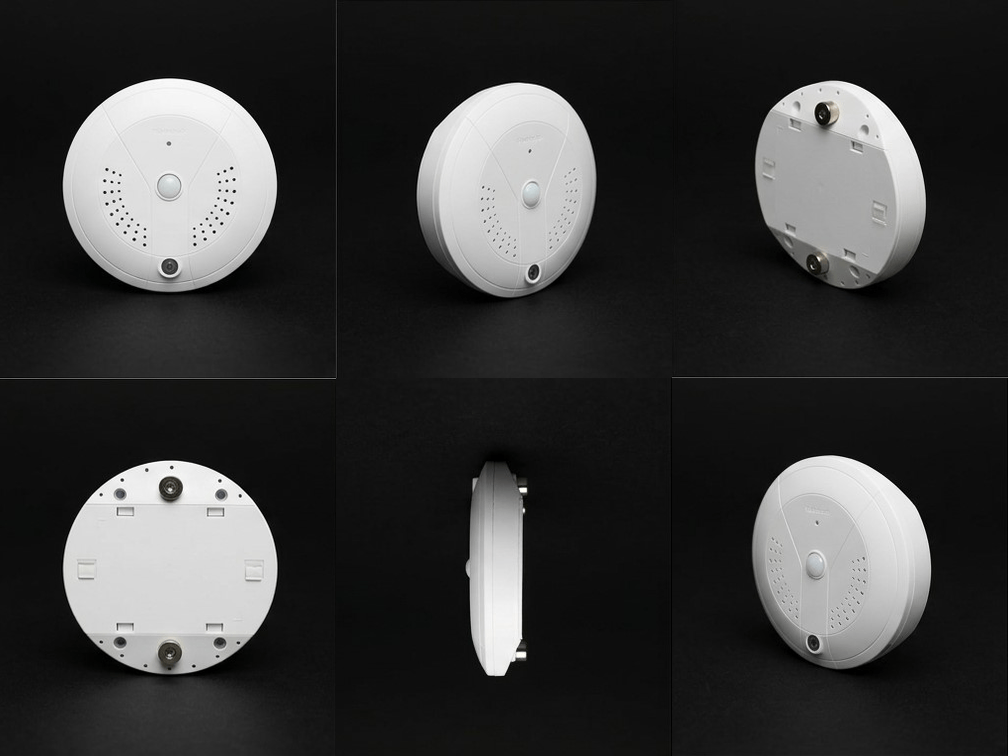
Effective solutions also demand strict adherence to “Privacy by Design.” PointGrab sensors utilize edge-AI processing to perform spatial inference locally on the device, extracting highly accurate headcount data without ever transmitting personally identifiable information (PII). To support massive enterprise deployments, PointGrab utilizes Thread networking protocols, offering superior scalability, data reliability, and standardized IP security compared to alternatives like LoRaWAN. This highly secure, real-time telemetry is delivered via REST APIs, seamlessly feeding into modern facility platforms where agentic AI and intelligent models can automatically orchestrate complex workflows and dispatch cleaning crews without human bottlenecking.
The ESG and Sustainability Angle
Demand-based cleaning has an environmental dimension that is increasingly relevant to corporate ESG reporting. Commercial cleaning chemicals, disposables, and equipment represent a measurable Scope 3 emissions contribution. Reducing unnecessary cleaning cycles means fewer chemicals consumed, less plastic waste from disposable materials, and lower cleaning vehicle fuel usage where services are contracted. Organizations tracking sustainability metrics can quantify this reduction and report it alongside energy and carbon savings. For facilities teams reporting to sustainability officers or ESG boards, occupancy-driven cleaning provides a concrete, data-backed example of operational sustainability in action. By integrating this sensor telemetry into building operations platforms, the reduction in cleaning cycles and resource waste can be directly quantified and automatically exported to centralized ESG dashboards. This provides stakeholders with the kind of granular, measurable improvement that effortlessly strengthens corporate ESG disclosures.
Stop paying to clean empty spaces. Discover how PointGrab’s edge-AI sensors can automate your facility workflows, protect employee privacy, and reduce cleaning costs by up to 30% today.
Demand-based cleaning works hand-in-hand with desk-level occupancy sensors, giving cleaning teams precise, zone-by-zone data. And since the sensor data is processed on-device, it is fully GDPR-compliant with no personal data captured.
Frequently Asked Questions
What is demand-based cleaning?
Demand-based cleaning adjusts cleaning schedules based on actual space occupancy and usage, rather than fixed pre-set schedules.
How do occupancy sensors enable demand-based cleaning?
Sensors show which areas are heavily used versus lightly used, allowing cleaning staff to prioritize high-traffic areas and adjust frequency accordingly.
What are the benefits of demand-based cleaning?
Benefits include reduced cleaning costs, improved cleanliness in frequently used areas, more sustainable resource use, and better staff allocation.
How much can demand-based cleaning save?
Organizations implementing demand-based cleaning typically reduce cleaning costs by 20–30% while maintaining or improving cleanliness standards in high-traffic areas.
How does demand-based cleaning improve employee experience?
High-traffic areas receive more frequent attention, improving cleanliness where it matters most, while less-used areas can be cleaned less frequently without impacting employee experience.
What data guides cleaning decisions?
Zone-level occupancy counts, historical usage patterns, and real-time traffic data from occupancy sensors determine optimal cleaning schedules. Thresholds can be configured so that cleaning is automatically dispatched when a space exceeds a defined usage level.
Can cleaning workflows be automated based on occupancy data?
Yes. With REST API integration, occupancy data feeds directly into facility management platforms where agentic AI models can automatically schedule cleaning dispatch, update rosters, and generate ESG reports without manual intervention.
Related Articles
- AI and Machine Learning in Facility Management: 6 Applications Transforming Smart Buildings
- How Occupancy Sensors Power Smart Building Automation: HVAC, Lighting, and Beyond
- The ROI of Occupancy Sensors: Building the Business Case for Workplace Intelligence
- Occupancy Sensors and Privacy: A GDPR-Ready Guide
- Desk Occupancy Sensors: The Case for Workstation Monitoring