How AI and Machine Learning Are Transforming Facility Management
Machine learning has moved from research labs to commercial buildings faster than most facility managers expected. Across the proptech sector, AI capabilities are moving beyond simply providing dashboards; they are acting as intelligent agents, delivering ‘Service-as-Software’ by solving problems and executing optimizations that were previously too complex, too data-intensive, or too dynamic for traditional building management systems to handle.
Here are six specific areas where AI facility management applications are delivering measurable value today — and where the technology is heading next.
1. Predictive Maintenance
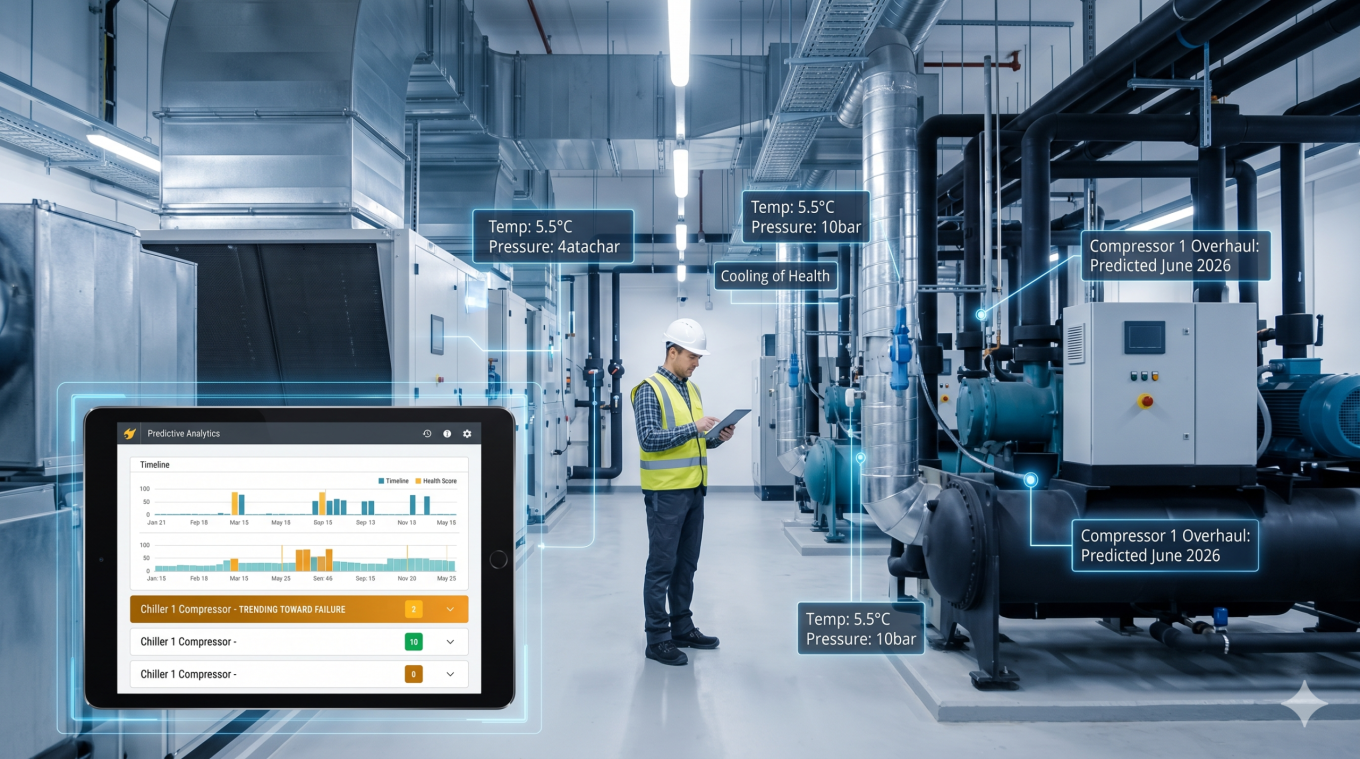
Predictive maintenance uses AI and ML algorithms to analyze data from interconnected building systems — HVAC compressors, lighting ballasts, elevator motors, plumbing sensors — and predict when maintenance is required before something breaks.
As Building Management Systems become more complex with dozens of interconnected subsystems, the volume of operational data exceeds what any human team can monitor manually. AI solves this by continuously analyzing real-time data streams, identifying patterns of wear, and flagging components that are trending toward failure.
The business case is straightforward: proactive fixes cost a fraction of emergency repairs, reduce equipment downtime, and extend the lifespan of building infrastructure. For large portfolio operators, predictive maintenance across multiple buildings can represent millions in avoided costs annually.

2. Energy Management Systems
AI-driven energy management optimizes heating, cooling, and lighting based on real-time occupancy patterns, weather forecasts, and utility rate schedules. Rather than running HVAC at full capacity on a fixed schedule, intelligent systems adjust dynamically based on who’s actually in the building.
Key capabilities include dynamic energy adjustment (reducing consumption during low-occupancy periods), peak load management (shifting energy use to avoid demand charges), and renewable energy integration (aligning solar production with consumption patterns).
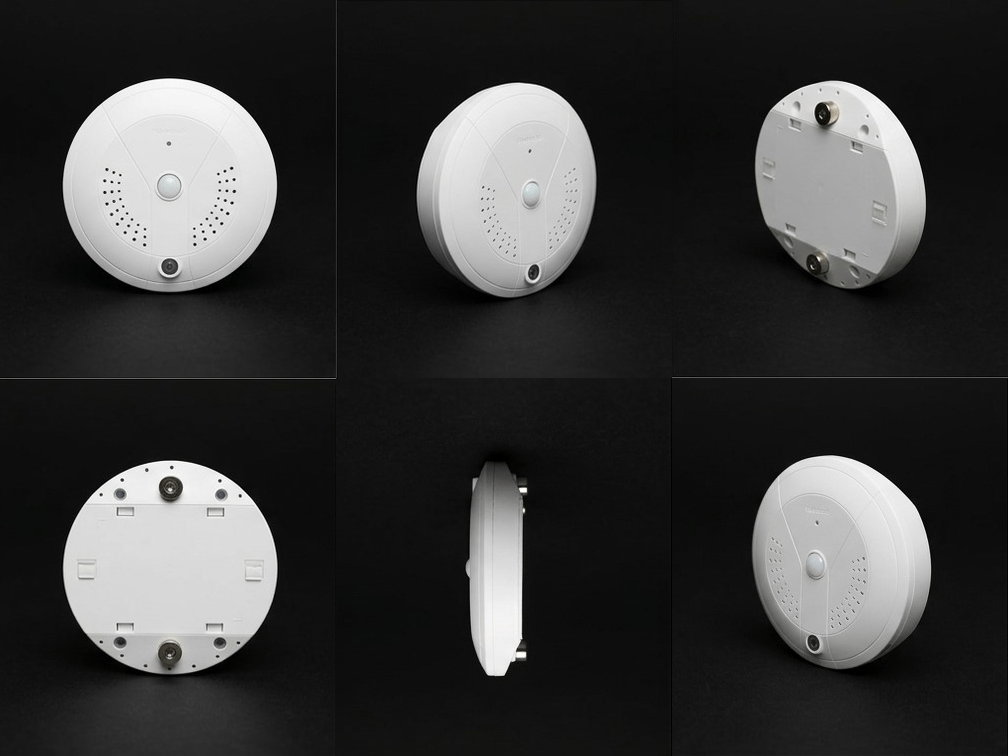
The occupancy data that powers these decisions often comes from ceiling-mounted occupancy sensors like PointGrab’s CogniPoint™, which feeds real-time zone-level occupancy to leading BMS platforms — including Siemens Building X, Johnson Controls OpenBlue, and Schneider Electric EcoStruxure — via cloud-based RESTful API. The result: buildings that breathe with their occupants rather than running blind on fixed schedules. For Class A commercial offices spending $3–5 per square foot on energy annually, a 20–30% reduction from occupancy-driven HVAC control represents $300,000–$750,000 in annual savings for a typical 500,000 sq ft facility — and provides measurable data for ESG and Scope 2 carbon reporting.

3. Indoor Air Quality Monitoring
AI-powered IAQ systems analyze data from sensors measuring CO2, volatile organic compounds (VOCs), particulate matter, humidity, and temperature. ML models predict air quality trends based on historical patterns — for example, automatically increasing ventilation before CO2 levels spike during peak afternoon occupancy.
By adjusting ventilation dynamically rather than running at maximum continuously, AI-driven IAQ systems reduce energy waste while maintaining healthier indoor environments. Post-pandemic, occupant expectations around air quality have risen significantly, making this a visible and valued investment for workplace leaders.

4. Smart Cleaning Solutions
Traditional cleaning operates on fixed schedules — every restroom cleaned twice daily, every desk wiped nightly, regardless of actual use. AI-driven cleaning flips this model by directing crews based on real occupancy data.
When occupancy sensors detect that a restroom, kitchen, or desk zone has been heavily used, cleaning alerts trigger automatically. Conversely, areas with low traffic get cleaned less frequently, saving labor hours without sacrificing hygiene. For large facilities, this reallocation of cleaning resources typically delivers 20–30% cost savings while actually improving cleanliness in the areas that matter most.

5. Space Utilization Analytics
This is where AI and occupancy sensing converge most directly. ML algorithms process continuous data from occupancy sensors to reveal how different spaces — desks, meeting rooms, collaboration zones, lounges — are actually used throughout the day, week, and season.
The insights go beyond simple headcounts. AI can identify behavioral patterns: which zones attract informal collaboration, which meeting rooms are chronically underused, which desk neighborhoods experience “ghost booking” patterns. These insights power data-driven workplace design decisions about space reallocation, floor consolidation, and office redesign — backed by months of continuous data rather than a one-day walkthrough.
PointGrab’s edge AI approach—showcased in our CogniPoint™ 2 Flex sensors—is distinctive here: the machine learning runs directly on the sensor hardware, processing visual data locally and transmitting only anonymous occupancy metadata. No images ever leave the ceiling-mounted device. This on-device processing delivers absolute privacy-by-design while drastically reducing network bandwidth requirements.

6. Security and Access Control
AI integrates with access control systems to detect unusual patterns — unauthorized after-hours access, abnormal movement in restricted zones, or occupancy anomalies that suggest tailgating. ML algorithms learn what “normal” looks like for each zone and flag deviations in real time.
When combined with occupancy sensors that track real-time presence without identifying individuals, building operators get enhanced situational awareness without the privacy concerns of camera-based surveillance. This is particularly relevant for organizations subject to GDPR, CCPA, or other privacy regulations.
The Common Thread: Occupancy Data as the Foundation
Across all six applications, the pattern is clear: AI in facility management is only as good as the data it receives. Predictive maintenance needs equipment sensor data. Energy management needs occupancy data. Cleaning needs usage data. Analytics needs behavioral data.
This is why a purpose-built occupancy sensing layer—delivering accurate, continuous, privacy-preserving spatial data over scalable, secure networks like Thread, rather than struggling with the limitations of older protocols like LoRaWAN—has become the foundation of the smart building technology stack. Without reliable, high-density occupancy data, AI systems are making decisions based on schedules, assumptions, and incomplete information.
With it, buildings become genuinely intelligent — adapting in real time to the people inside them.
For two of the most impactful AI-powered FM applications, explore demand-based cleaning and smart building automation — both powered by the same occupancy data layer.
Ready to learn more? Contact PointGrab for a consultation.
Related Articles
- The Complete Guide to Occupancy Sensors for Modern Offices
- The Workplace Data Problem: Why Your Office Needs a Spatial Data Layer
- The ROI of Occupancy Sensors: Building the Business Case for Workplace Intelligence
- Demand-Based Cleaning: How Occupancy Data Is Transforming Facility Maintenance
- How Occupancy Sensors Power Smart Building Automation
Frequently Asked Questions
How are AI and machine learning used in facility management?
AI and ML analyze occupancy data to predict space needs, optimize maintenance schedules, reduce energy consumption, and improve space allocation decisions.
What problems does AI solve in facility management?
AI addresses challenges like predicting peak occupancy times, automating maintenance scheduling, detecting anomalies in space usage, and optimizing HVAC and lighting efficiency.
How does predictive analytics help with space planning?
By analyzing historical occupancy patterns, ML models predict future space demand, helping facility managers make proactive adjustments to layouts and capacity.
Can AI prevent building system failures?
Yes, AI-driven monitoring can detect unusual patterns in equipment behavior, predicting failures before they occur and reducing costly downtime.
What data do AI systems need to be effective?
AI requires continuous occupancy data, equipment sensor readings, environmental conditions (temperature, humidity), and space usage patterns to train accurate predictive models.
How does AI improve energy efficiency?
Machine learning analyzes occupancy patterns and environmental data to automatically adjust HVAC, lighting, and other systems, reducing energy waste by 15–30%.