
Why Software-Agnostic Occupancy Data Matters: Avoiding Vendor Lock-In
Most occupancy sensor vendors sell you hardware and software as a bundle. Buy their sensors, use their analytics platform, see insights through their dashboard. It feels integrated. It feels convenient—until it becomes an expensive bottleneck that limits your building’s potential.
The Vendor Lock-In Problem
When your occupancy sensors only work with one analytics platform, you face several long-term consequences. You cannot choose best-of-breed analytics. Your workplace analytics tool, your BMS, your space booking platform — all would benefit from occupancy data, but the sensor vendor only feeds their own system. Switching costs escalate. If you want to change analytics platforms in three years, you may need to replace all your sensors too. Hardware that should have a 7-10 year lifespan becomes obsolete when you change software. Data portability is limited. Your historical occupancy data lives inside the vendor’s platform. If you leave, that data may not come with you — or comes in a format that requires expensive migration.
The Software-Agnostic Alternative
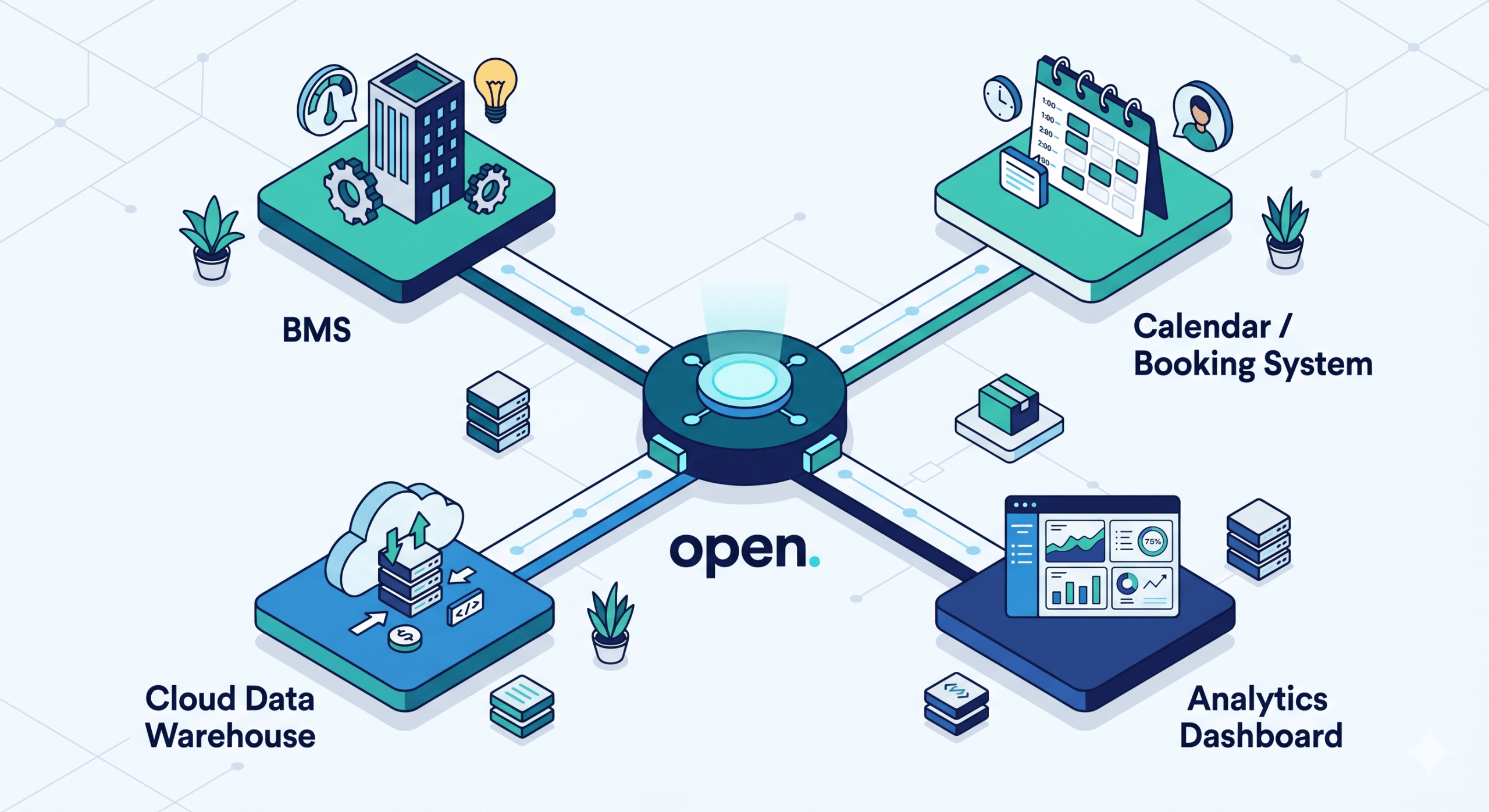
A software-agnostic sensor is a data source, not an ecosystem. It detects occupancy and delivers raw data through open protocols — letting you decide where that data goes and what you do with it.
PointGrab built CogniPoint sensors on this principle. Our sensors deliver occupancy data via a cloud-based RESTful API (the standard for modern software integration). This means the same sensor data can simultaneously feed your workplace analytics platform (whichever you choose), your building management system for HVAC and lighting control, your space booking system for auto-release and availability, your enterprise data warehouse for long-term analysis, and your ESG reporting tools for sustainability metrics.
For a full protocol comparison, see our technical guide on building an application-agnostic occupancy data layer.
Cloud-Based REST API: The Integration Standard
PointGrab CogniPoint sensors deliver occupancy data to the PointGrab cloud platform via a secure cloud-based RESTful API — the standard protocol for modern software integration. REST APIs are supported by every enterprise BMS, IoT platform, and analytics tool in the market, including Siemens Building X, Johnson Controls OpenBlue, Schneider Electric EcoStruxure, as well as leading workplace and environmental platforms like Wellstat. This means PointGrab integrates cleanly into your existing technology stack without custom middleware or vendor-specific bridges.
This matters because buildings increasingly need occupancy data in multiple systems simultaneously. Your facilities team wants it in the BMS — whether that is Siemens, Johnson Controls, Schneider Electric, or another platform. Your workplace team wants it in their analytics platform. Your IT team wants it in the enterprise data lake. Your sustainability team wants it feeding ESG reporting dashboards. A software-agnostic sensor architecture built on REST APIs serves all of these needs from a single cloud-based integration point.

The Strategic Advantage
Organizations that choose software-agnostic sensing infrastructure gain flexibility that compounds over time. When a better analytics platform emerges, you adopt it without replacing hardware. When a new use case emerges — say, ESG reporting or cleaning optimization — you route existing data to a new system rather than deploying new sensors. Looking ahead, this raw, un-siloed data will be the essential fuel for Agentic AI and Service-as-Software platforms. Future AI agents tasked with autonomously managing workplace efficiency simply cannot function within locked hardware ecosystems. This is the difference between buying a data layer and buying a product ecosystem. A data layer appreciates in value and future-proofs your building for autonomous management, while a product ecosystem creates switching costs that increase over time.
Want occupancy data that works with your entire tech stack? PointGrab’s cloud-based REST API architecture gives you complete data freedom. See how it integrates with your systems.
5 Questions to Ask Your Occupancy Sensor Vendor
Before committing to any occupancy sensing platform, use these questions to test whether you’re buying a data layer or a lock-in contract:
1. Can I access raw occupancy data via a standard REST API without paying for a premium tier? If the answer is “only on the enterprise plan,” data access is a feature, not a right.
2. Can I export all historical data if I switch vendors? Vendors who can’t answer this clearly are the ones most likely to hold your data hostage later.
3. Does my BMS, IWMS, or BI tool connect directly to your sensor data, or only through your dashboard or analytics API? If only through the dashboard or analytics API, every integration is mediated by the vendor’s platform — and disappears if you leave.
4. If I replace your sensors with a competitor’s in three years, what happens to my existing integrations? Truly software-agnostic vendors will walk you through this scenario without hesitation.
5. What protocol does your sensor use to deliver data — and is there a proprietary middleware layer involved? Some wireless sensors require a proprietary network server between the sensor and your systems. Ask for the full data path diagram.
Software-agnostic design also supports compliance — see our GDPR-ready privacy guide to understand how open data flows and privacy by design go hand in hand.
Frequently Asked Questions
What does software-agnostic mean for occupancy data?
Software-agnostic means occupancy data can be used with any building management, space booking, or analytics platform, not locked into one vendor.
Why is data portability important for facilities?
Data portability prevents vendor lock-in, allows organizations to choose best-fit tools, and protects long-term flexibility as technology evolves.
How do you ensure occupancy data is truly agnostic?
Use open standards, avoid proprietary data formats, maintain direct database access, and choose sensors with clear data export capabilities.
What happens if occupancy data is locked into one platform?
Lock-in increases long-term costs, limits integration options, and creates switching penalties if you want to change vendors.
Can you integrate occupancy data with multiple systems?
Yes, with proper data standards and APIs, occupancy data can integrate with workplace management systems, building controls, analytics platforms, and more.
What data standards support agnostic occupancy systems?
Open standards like REST APIs and schema-agnostic JSON formats ensure occupancy data can move freely between systems. PointGrab delivers data via cloud-based RESTful API, enabling integration with any platform without proprietary middleware.
Related Articles
- Building an Application-Agnostic Occupancy Data Layer: Cloud-Based REST APIs and the Case Against Vendor Lock-In
- The Complete Guide to Occupancy Sensors for Modern Offices
- PIR vs. Thermal vs. Optical vs. Edge AI: Which Occupancy Sensor Technology Is Right for Your Office?
- The Workplace Data Problem: Why Your Office Needs a Spatial Data Layer
- Occupancy Sensors and Privacy: A GDPR-Ready Guide