
PIR vs Thermal vs Traditional Optical vs Image Based Edge AI: Which Occupancy Sensor Technology Is Right for Your Office?
Choosing an occupancy sensor technology is one of the most consequential decisions a workplace team will make. The sensor you pick determines the quality of data you collect, the privacy posture of your organization, and ultimately whether your space optimization efforts succeed or fail.
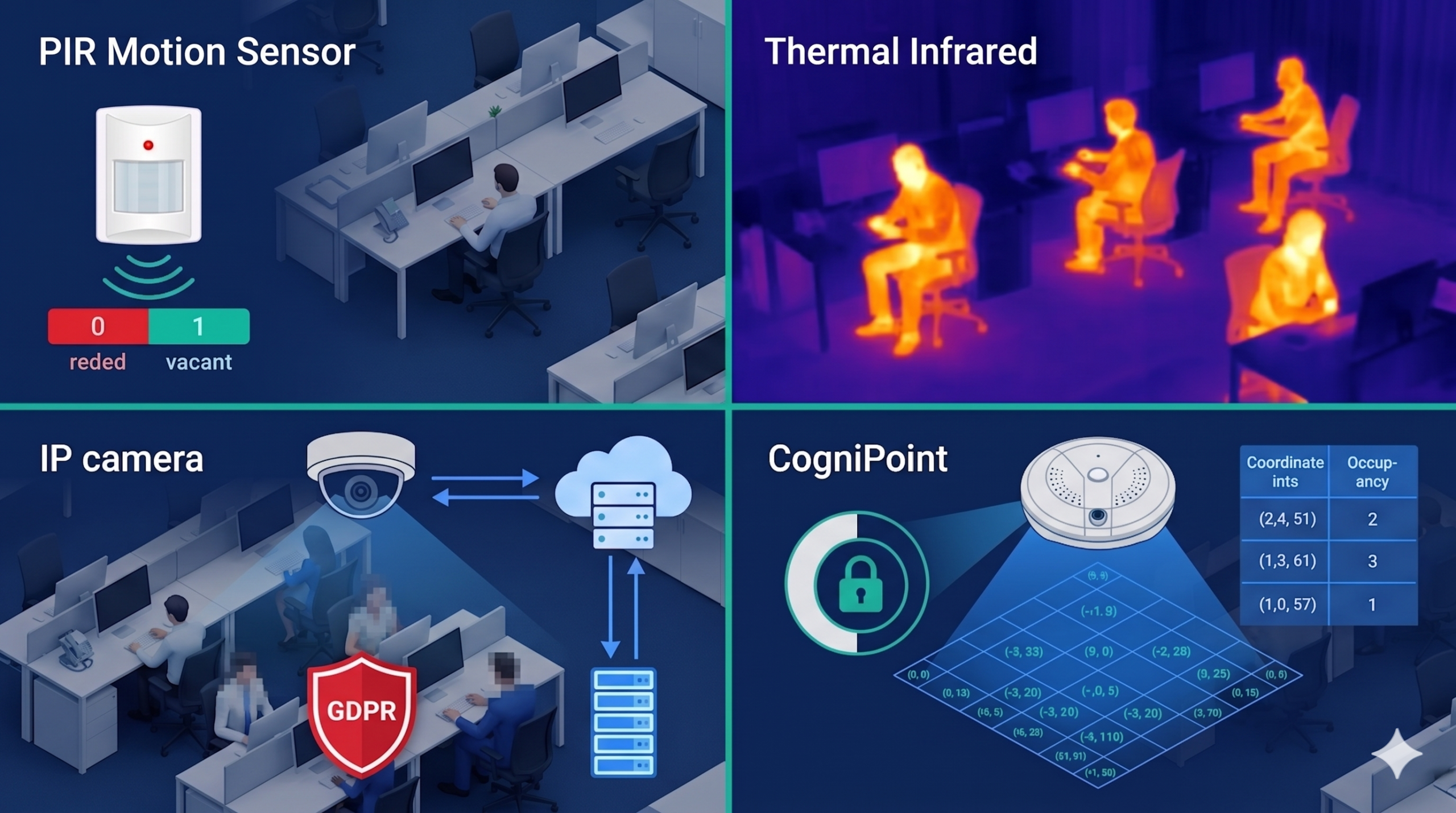
Four sensor technologies are used for workplace occupancy today: PIR (passive infrared), thermal infrared, traditional camera/optical, and Image Based edge AI. Each takes a fundamentally different approach to detecting and counting people in office spaces. PIR is the legacy standard; optical edge AI is the modern benchmark. Understanding the trade-offs is essential before committing budget and infrastructure.
PIR Sensors: The Legacy Standard
Passive infrared (PIR) sensors are the most widely deployed occupancy technology in commercial buildings — and the most limited. PIR detects changes in infrared radiation caused by body heat moving across the sensor’s field of view. The result is a binary signal: motion detected, or no motion detected.
This binary output is PIR’s fundamental limitation. PIR cannot count people — it only detects whether someone is moving. A perfectly still person at their desk registers as vacant. A room with twenty people reads the same as a room with one. PIR data cannot support desk-level granularity, accurate headcounts, or meaningful space utilization analytics.
PIR remains viable for basic lighting automation — turning lights off when a space is empty — but falls short of any analytical or optimization use case. Organizations relying on PIR data for space planning are working from an incomplete picture. The familiar frustration of waving at a ceiling sensor to get the lights back on is a daily reminder of PIR’s constraints.
Thermal Infrared Sensors: Privacy-First, Accuracy-Limited
Thermal sensors detect body heat signatures to determine whether people are present. Companies like Butlr have built their entire positioning around this approach, emphasizing that thermal cannot capture personal identifying information.
The privacy story is compelling. Thermal sensors genuinely cannot identify individuals — they see heat, not faces. For organizations with stringent privacy requirements, this feels safe.
But thermal has real limitations. Resolution is inherently constrained by the physics of heat detection. In warm environments — near HVAC vents, kitchens, or in summer conditions — accuracy degrades. Thermal sensors struggle to distinguish between people sitting close together, and their spatial resolution cannot match optical approaches for desk-level granularity.
Thermal works well for basic presence detection in privacy-sensitive spaces. It struggles when you need precise headcounts or spatial positioning data.
Traditional Camera/Optical Sensors: Accurate but Privacy-Challenged
Camera-based sensors like those from VergeSense use optical imaging combined with AI to count people and map spaces. The accuracy is generally high — cameras can distinguish individual people, track movement, and provide rich spatial data.
The challenge is privacy. Even with blurring and anonymization, camera-based systems fundamentally capture images of people. In the European Union, GDPR creates real compliance complexity around camera-based workplace monitoring. Employee works councils in Germany and France have historically pushed back against camera deployment.
Camera systems also typically require cloud processing, meaning images leave the device and travel to external servers for analysis. Even with encryption, this creates a larger attack surface for privacy breaches.
For a side-by-side breakdown of all sensor technologies across key metrics, see our full guide to occupancy sensor technologies compared.
Image Based Edge AI: The Best of Both Worlds
Edge AI sensors represent the newest approach and address the core trade-off between accuracy and privacy. These sensors use optical sensing — capturing the scene visually — but process everything on the device itself. No images are ever stored, transmitted, or accessible. The only output is anonymized coordinate data.
This means you get the accuracy advantages of optical sensing (precise headcounts, sub-meter positioning, desk-level granularity, area heatmaps) combined with the privacy advantages of thermal (no personal data, no images, no identification capability).
PointGrab’s CogniPoint sensors use this edge AI approach. The sensor sees the space optically for accuracy, but the AI runs locally on the chip — outputting only MQTT/REST data points that cannot be reverse-engineered into images.
For a deep technical look at how on-device neural networks power this approach, see our guide to edge AI occupancy sensing.

The Comparison at a Glance
- PIR: Binary presence detection only (motion/no motion), cannot count people, no spatial data, good for basic lighting control only. Widely deployed but inadequate for space analytics.
- Thermal: Strong privacy narrative, can count people (limited resolution), limited spatial granularity, affected by environmental heat sources. Best for privacy-sensitive spaces where approximate headcounts suffice.
- Traditional Camera/Optical (Cloud AI): High accuracy, cloud processing required, significant privacy concerns and GDPR complexity, not suitable for privacy-regulated environments.
- Image based Edge AI (e.g., PointGrab CogniPoint): Optical accuracy with on-device processing, no images stored or transmitted, strong privacy architecture, exact headcounts, sub-meter positioning, desk-level granularity. Best of both worlds.
What Should Drive Your Decision?
If you only need basic lighting automation and already have PIR infrastructure, there is no immediate need to replace it — PIR does that job adequately. If you need only approximate headcounts in privacy-sensitive spaces and exact positioning is not critical, thermal is a reasonable step up. If you need rich spatial data and operate in a region with less restrictive privacy regulations, traditional cloud-based cameras provide high accuracy but come with compliance overhead.
But if you need accurate headcounts, desk-level positioning, area heatmaps, AND genuine privacy compliance — edge AI is the technology that doesn’t force a trade-off. You get the data quality of optical sensing with a privacy architecture that satisfies even the most stringent GDPR requirements.
The workplace sensor market is maturing rapidly. The technology you choose today will define your data quality for years to come. Choose the approach that gives you both the accuracy and the privacy your organization needs.
Once you’ve chosen your sensor technology, the next step is designing the deployment. Our workplace sensing infrastructure guide covers placement strategy, data protocols, and integration architecture.
Ready to see edge AI occupancy sensing in action? Request a demo of PointGrab’s CogniPoint sensors and see how optical edge AI delivers the accuracy your space optimization decisions require.
Once you’ve chosen the sensor type, the next step is deployment — see our comparison of wired vs wireless occupancy sensors to plan your installation approach.
Frequently Asked Questions
What is a thermal sensor?
Thermal sensors detect infrared heat signatures from people, providing presence detection without visual identification.
What is an optical sensor?
Optical sensors use camera-based technology to detect movement and occupancy, offering more detailed spatial data.
How do thermal sensors compare to optical sensors for privacy?
Thermal sensors are generally considered more privacy-friendly because they don’t capture visual details, only heat signatures.
Which sensor type is more accurate?
Accuracy depends on environment and use case. Thermal excels in dim conditions, while optical performs better with complex spatial layouts.
Can thermal sensors detect occupancy through obstacles?
Thermal sensors can sometimes detect heat through thin materials, but performance depends on the specific sensor and material properties.
What’s the cost difference between thermal and optical sensors?
PIR sensors are the lowest-cost entry point (often already installed for lighting). Thermal sensors cost more per unit but provide actual headcounts. Traditional camera/optical systems vary widely — hardware may be cheaper but cloud processing and integration add ongoing cost. Optical edge AI sensors like PointGrab’s CogniPoint carry a higher per-unit cost than PIR or basic thermal, but deliver the data quality needed to justify space investments in the six- and seven-figure range.
Which is better for meeting rooms?
For meeting rooms requiring exact headcounts and auto-release based on actual occupancy, optical edge AI is the strongest choice — providing both precise counts and privacy compliance. Thermal is a reasonable option for smaller rooms in highly privacy-regulated environments where exact headcounts are less critical.
What is the difference between PIR and optical occupancy sensors?
PIR sensors detect motion from heat changes and output only a binary signal — occupied or vacant. Optical sensors (especially optical edge AI like CogniPoint) detect actual people, count them precisely, and provide spatial position data. PIR tells you if anyone moved; optical edge AI tells you exactly how many people are where at any moment.
Can PIR sensors be upgraded to provide occupancy counts?
No — PIR sensors cannot be upgraded to count people. The technology is fundamentally binary. Organizations that need headcount data, space utilization analytics, or desk-level occupancy must deploy a different sensor technology. PIR can coexist with counting sensors (using PIR for lighting, counting sensors for analytics), but cannot substitute for them.
Related Articles
- The Complete Guide to Occupancy Sensors for Modern Offices
- Occupancy Sensors and Privacy: A GDPR-Ready Guide for European Workplaces
- How Occupancy Sensors Power Smart Building Automation: HVAC, Lighting, and Beyond
- Wired vs Wireless Occupancy Sensors: Choosing the Right Deployment
- Wi-Fi Tracking vs Dedicated Sensors: What Workplace Teams Need to Know