Wired vs Wireless Occupancy Sensors: Choosing the Right Deployment for Your Building
One of the first practical decisions in any occupancy sensor deployment is connectivity: wired or wireless? The answer impacts installation cost, deployment timeline, reliability, and long-term flexibility — and the right choice depends on your building, your timeline, and your scale ambitions.
Here’s an honest comparison of both approaches, including where the industry is heading with next-generation wireless occupancy sensor technology.
Wired Sensors (Power over Ethernet)
Wired occupancy sensors connect to the building’s network via Ethernet cables that carry both data and power (PoE). This is the traditional deployment model and remains the gold standard for reliability.
Advantages: Constant power means no battery management. Wired data transmission is inherently more reliable than wireless. PoE infrastructure often already exists in modern office buildings, especially in meeting rooms and common areas. For permanent installations in new construction or major renovations, wired is the natural choice.
Considerations: Running new Ethernet cables to every sensor location adds cost and time. In heritage buildings or spaces with limited ceiling access, cabling can be disruptive. Each sensor requires a PoE port, which may mean upgrading network switches. Installation timelines are typically measured in weeks rather than days.
Wireless Sensors (Battery + Wi-Fi or Thread)
Wireless sensors eliminate the need for Ethernet cabling, connecting instead via Wi-Fi, Bluetooth, or newer mesh protocols like Wirepas or Thread. They run on batteries or low-voltage DC power, dramatically simplifying installation.
Advantages: Rapid deployment — mount the sensor, configure it, and it’s live. No dependency on cabling contractors or PoE infrastructure. Ideal for retrofitting existing spaces, running pilots, or deploying in temporary or frequently reconfigured environments. Highly scalable across large portfolios.
Considerations: Battery life is a key factor — frequent battery changes create ongoing maintenance. Wireless connectivity can be less reliable than wired in environments with heavy RF interference. Early wireless sensors suffered from limited bandwidth, but modern Thread mesh networking addresses many of these concerns with self-healing, low-power mesh topologies.
Side-by-Side Comparison
| Feature | Wired (PoE) | Wireless (Battery/Wi-Fi) |
| Power Source | Power over Ethernet — data + power in one cable, or DC power + Wi-Fi | Battery |
| Installation Complexity | Requires PoE switch and Ethernet cabling to each sensor | Minimal infrastructure — mount and configure, floor-wide gateway |
| Reliability | Constant power + wired data = highest reliability | Battery life dependent; modern Thread mesh improves resilience |
| Deployment Speed | Dependent on cabling infrastructure (weeks) | Rapid deployment possible (days) |
| Scalability | Dependent on available PoE ports and cable runs | Highly scalable — no cable constraints |
| Best For | New construction, renovations, permanent installations | Retrofits, temporary spaces, rapid pilots, large rollouts |
| PointGrab Option | CogniPoint (PoE) | CogniPoint 2 Flex (battery + Thread, GA Q3/2026) |
The Industry Trend: Wireless Is Accelerating
The occupancy sensor market is moving decisively toward wireless. Several factors drive this shift:
- Thread protocol maturity & security — Thread provides IP-based mesh networking with self-healing capabilities and low power consumption. More importantly for enterprise IT departments, it utilizes a standardized IP security architecture, bringing enterprise-grade, end-to-end encryption to commercial IoT sensors without the vulnerabilities of older legacy protocols.
- Battery technology improvements — Modern sensors achieve multi-year battery life, reducing the maintenance burden that historically limited wireless deployments.
- Deployment speed demands — Organizations want to pilot in weeks, not months. Wireless enables this with minimal IT involvement.
- Retrofit economics — The majority of sensor deployments are in existing buildings where running new cables is expensive and disruptive.

PointGrab’s Approach: Both, from One Platform
PointGrab offers both deployment models from the same platform:
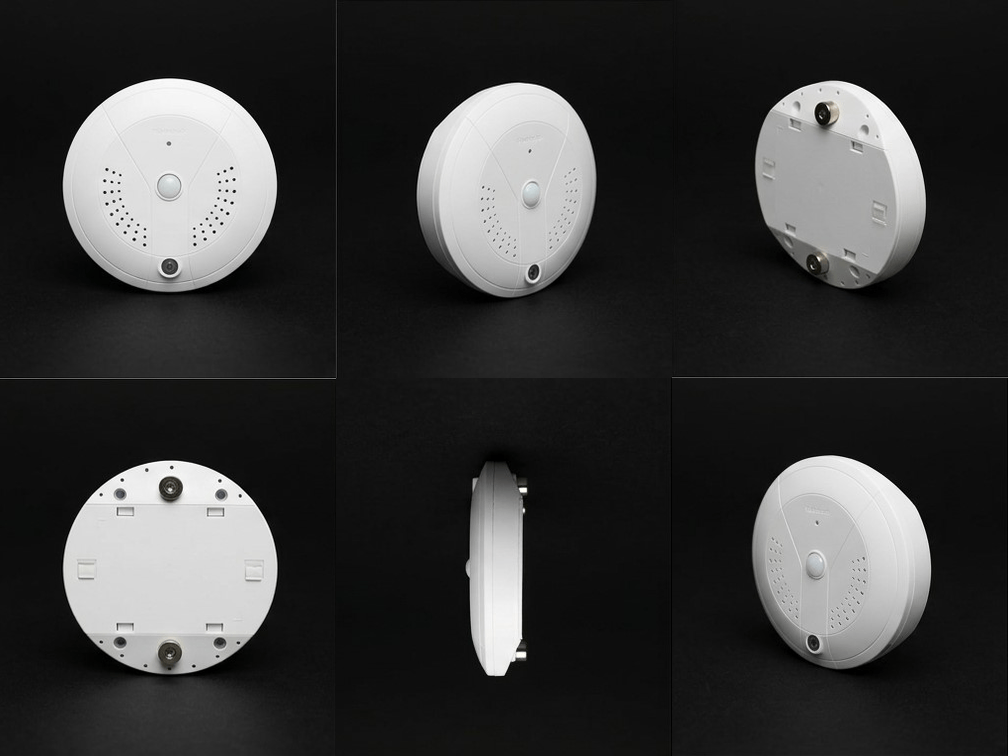
CogniPoint (wired) connects via PoE or DC (with Wi-Fi connectivity), delivering the highest reliability for permanent installations. It’s deployed in over 500 installations across nearly 40 Fortune 500 companies.
CogniPoint 2 Flex (wireless) — announced February 2026 — utilizes Thread mesh connectivity. It’s designed for rapid, large-scale deployment with zero cabling. Crucially, both our wired and wireless models operate on a strict “Privacy by Design” architecture. The same edge AI engine performs all spatial inference locally on the device itself. No images or personally identifiable information (PII) are ever transmitted over the network. You get the same cloud APIs, the same enterprise-grade IP security standard to Thread, and the same data quality — just without the wires.
Both models feed into the same software-agnostic data layer via PointGrab’s cloud-based RESTful API, integrating natively with leading BMS platforms as well as workplace analytics tools, booking systems, digital signage and IWMS platforms. Organizations can mix wired and wireless sensors across their portfolio and receive consistent data regardless of the connectivity model. Start with a wired pilot in one building and expand wirelessly across the portfolio — or vice versa.
How to Decide
The decision framework is straightforward:
- The New Build or Major Renovation — Choose wired if you are building out a new space, taking spaces down to the studs, or already have extensive PoE infrastructure in place. It provides the highest baseline reliability and eliminates future battery maintenance.
- The Heritage Retrofit & Rapid Rollout — Choose wireless if you are retrofitting existing, occupied offices, dealing with difficult ceiling access, or need to deploy across multiple global locations in weeks rather than months. It drastically reduces IT and facilities disruption.
- The Mixed Real Estate Portfolio — Choose both if you manage a diverse portfolio of permanent headquarters and agile flex spaces. PointGrab’s unified data platform allows you to mix wired and wireless sensors effortlessly, delivering consistent, reliable occupancy data regardless of the connectivity model on the ceiling.
Ready to optimize your workplace? Contact us today to schedule a personalized consultation for your portfolio.
Before committing to a deployment approach, also review the broader connectivity landscape — our Wi-Fi vs dedicated sensor comparison and Thread mesh networking guide cover the tradeoffs in detail.
Frequently Asked Questions
What’s the difference between wired and wireless occupancy sensors?
Wired sensors connect directly to electrical and data infrastructure, offering reliability and power, while wireless sensors use batteries and radio communication for easier installation.
What are the advantages of wired sensors?
Wired sensors provide consistent power, faster data transmission, no battery replacement, and often lower long-term costs in large deployments.
What are the advantages of wireless sensors?
Wireless sensors offer easier installation (no running cables), flexibility in placement, faster deployment, and lower upfront infrastructure costs.
Which type is better for retrofitting existing buildings?
Wireless sensors are typically better for retrofits because they don’t require extensive cabling, reducing installation disruption and costs.
How long do wireless sensor batteries last?
Most quality wireless sensors have battery lifespans of 3–7 years depending on transmission frequency and usage patterns.
Can wired and wireless sensors work together?
Yes, a hybrid approach using both wired and wireless sensors can optimize coverage while managing installation complexity and costs.
What’s the cost difference between wired and wireless?
Wireless sensors typically have higher per-unit costs but lower installation expenses, while wired systems have higher installation costs but lower per-unit prices in large deployments.
Related Articles
- The Complete Guide to Occupancy Sensors for Offices
- Occupancy Sensor Technologies Compared: PIR vs Thermal vs Optical vs AI
- How AV Integrators Can Expand Beyond Meeting Rooms
- Wi-Fi Tracking vs Dedicated Sensors: What Workplace Teams Need to Know
- Thread Mesh Networking for Commercial Buildings
- The ROI of Occupancy Sensors: Building the Business Case