Ghost Bookings Are Costing You More Than You Think: Data-Driven Solutions for Meeting Room No-Shows
Your calendar says the office is full. Your eyes say it’s empty. This is the multi-million dollar disconnect costing your workplace. Across enterprise offices, 30–40% of booked meeting rooms go completely unused. This phantom demand creates a cascade of problems that goes well beyond wasted space.
The True Cost of Ghost Bookings
When meeting rooms appear booked but sit empty, employees cannot find available rooms even when plenty are physically empty. This drives frustration, reduces collaboration, and pushes people to book rooms defensively — reserving more rooms than they need, just in case.
The financial impact is significant. If ghost bookings block 30% of your meeting room capacity, and you have 100 meeting rooms, you are effectively operating with only 70 available rooms. Many organizations respond by building more meeting rooms — at $50,000-$100,000 per room in build-out costs — to solve a problem that is actually about data, not space.
Why Booking Systems Alone Cannot Solve This
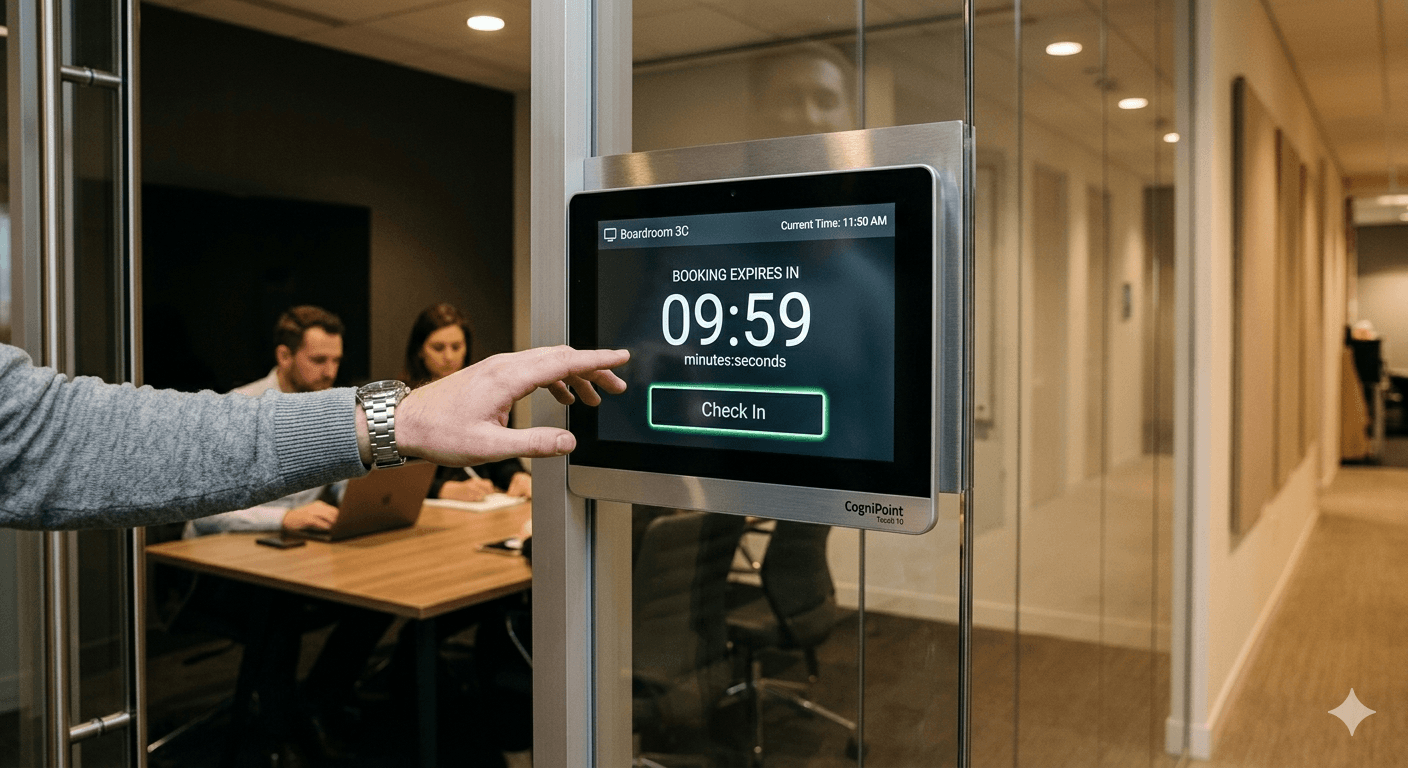
Most meeting room booking systems have a check-in feature or an auto-release timer. Book a room, and if nobody checks in within 10-15 minutes, the room is released. The theory is sound; the practice has problems.
Manual check-in has low adoption. People forget, ignore, or resent the extra step. Compliance rates for manual check-in typically hover around 50-60%. Timer-based release is slow. A 15-minute grace period means the room sits empty for at least 15 minutes before it becomes available — and then only if the system releases it correctly. Neither approach detects early departures. If a 60-minute booking ends after 30 minutes, the room stays blocked for the remaining 30 minutes.
The Sensor-Based Solution
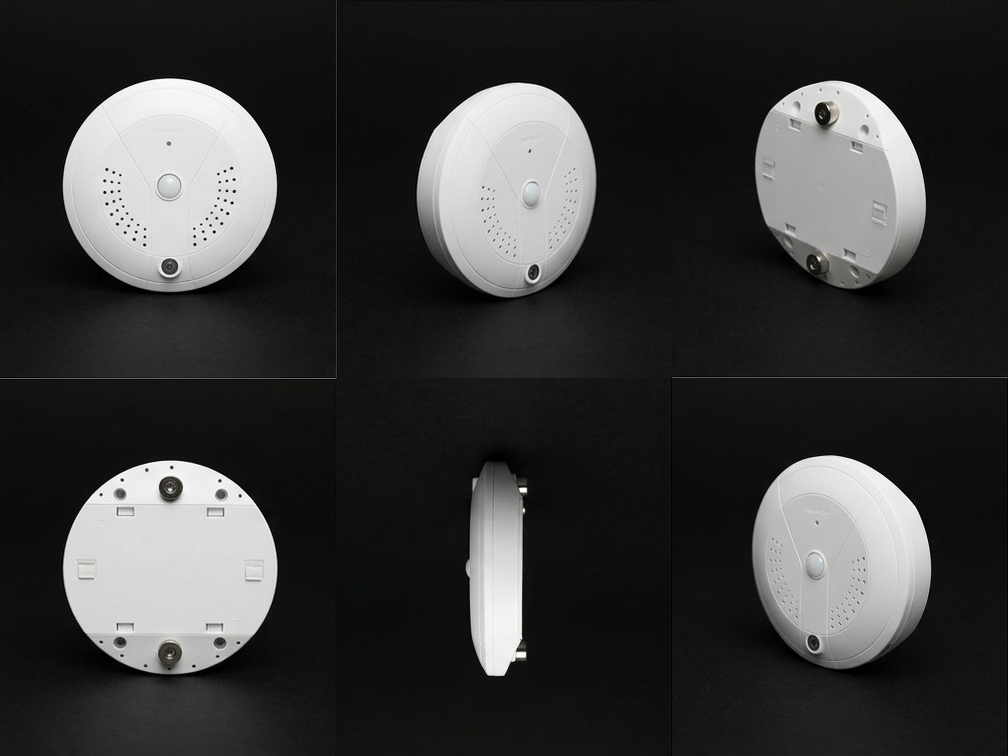
Occupancy sensors transform meeting room management by providing ground truth: is anyone actually in the room, right now? When sensors detect that a booked room has been empty for a configurable period (typically 5-10 minutes), the booking system can automatically release the room and make it available for others.
Crucially, modern sensor networks achieve this ground truth through Privacy by Design. By utilizing edge-AI processing, advanced sensors perform spatial inference locally on the device itself. This means accurate occupancy and headcount data is captured to trigger auto-release without ever transmitting, capturing, or storing personally identifiable information (PII), neutralizing employee privacy concerns entirely.
More importantly, sensors detect when meetings end early, freeing the room immediately rather than holding it for the full booked duration. In a typical office, this reclaims an additional 15-20% of meeting room capacity that timer-based systems miss entirely.

The WASH Index Connection
Ghost bookings are a key driver of the WASH Index (Wasted Available Seat Hours) — PointGrab’s metric for meeting room abuse. WASH measures how much capacity is lost when rooms are booked by one or two people but configured for ten. Across our customer deployments, the average WASH Index runs around 15%, representing millions of dollars in underutilized meeting infrastructure.
Sensors that provide accurate headcount (not just presence detection) reveal both ghost bookings (empty rooms) and room right-sizing opportunities (large rooms with few occupants). This dual insight is only possible with counting-capable sensors — PIR sensors that only detect presence/absence miss half the picture.
Implementation Best Practices
Start with measurement before intervention. Deploy sensors and measure ghost booking rates for 2-4 weeks before enabling auto-release. This creates a baseline and helps identify the worst-offending rooms and teams. Set reasonable grace periods. 5-10 minutes balances responsiveness with allowing for late arrivals. Communicate the change. Frame auto-release as an employee benefit (more rooms available) rather than a policy enforcement tool. Feed AI workflows to right-size and expand. Advanced telemetry data does more than just release rooms; it powers the future of workplace automation. By feeding accurate, real-time sensor data into agentic AI workflows, LLM-driven facility agents can automatically generate right-sizing recommendations—such as swapping underutilized boardrooms for 2-4 person huddle spaces. Furthermore, this undeniable usage data can alert business development teams to expansion or layout optimization opportunities long before manual audits would catch them.
Ghost bookings are ultimately a space efficiency problem — review your employee-to-seat ratio and quantify the full financial impact with our occupancy sensor ROI guide.
Stop building empty rooms to solve a data problem. PointGrab’s edge-AI sensors provide the real-time, privacy-first occupancy data that makes auto-release actually work—reclaiming your lost meeting capacity today. See how.
Related Articles
- Meeting Room Abuse: How the WASH Index Exposes Hidden Space Waste
- How to Design the Best Huddle Room for Your Hybrid Workplace
- The Complete Guide to Occupancy Sensors for Modern Offices
- The ROI of Occupancy Sensors: Building the Business Case
- Employee-to-Seat Ratio: How to Calculate and Optimize Your Office Space
Frequently Asked Questions
What are ghost bookings?
Ghost bookings are meeting room reservations that go unused — where a room is booked but nobody shows up or the meeting is cancelled without releasing the room.
How common are ghost bookings?
Studies show that 30–40% of meeting room bookings go unused in enterprise offices, representing significant wasted capacity and cost.
How do occupancy sensors detect ghost bookings?
Sensors confirm whether a booked room is actually occupied. If the room remains empty beyond a configurable grace period (typically 5–10 minutes), the system automatically releases the booking and makes the room available to others.
What causes ghost bookings?
Common causes include meetings cancelled without updating the calendar, defensive over-booking to guarantee availability, and the rise of single-person video calls booked in huddle rooms.
How much does ghost booking cost?
A company with 100 conference rooms and a 35% no-show rate effectively operates with only 65 available rooms. Many organizations respond by building more meeting rooms — at $50,000–$100,000 per room — to solve what is actually a data problem.
How can occupancy data reduce ghost bookings?
Real-time occupancy data enables automatic room release, highlights the worst-offending rooms and teams, and informs room-mix redesign — replacing underused large rooms with the smaller huddle spaces that reflect actual meeting patterns.
Should organizations penalize ghost bookings?
Positive incentives, awareness campaigns, and smart auto-release features are more effective than penalties. Framing auto-release as a benefit — “more rooms available for everyone” — drives higher adoption and cultural change.