
The Quiet Space Deficit: Why Your Office Needs More Focus Zones (and How to Design Them)
Open offices promised collaboration. They delivered noise. As organizations bring employees back to the office, one of the most consistent pieces of feedback is that there are not enough quiet places to do focused work. Occupancy data confirms what employees have been saying: quiet spaces are the most in-demand and most undersupplied space type in modern offices.
The Focus Work Problem
Knowledge workers spend approximately 60% of their time on individual, focused work — reading, writing, coding, analyzing, thinking. Yet the open office floor plan, which dominates modern workplace design, was optimized for the other 40%: collaboration, communication, and teamwork.
The result is a fundamental mismatch. Return-to-office mandates from major employers — Amazon, JPMorgan Chase, and others requiring five days per week — have sharply increased office headcount without a corresponding increase in quiet space supply. People come to the office because they are required to, and find it harder to focus than at home. The noise, visual distractions, and interruptions of open plan environments drive people to work from meeting rooms, stairwells, and even their cars — anywhere they can find quiet.
What the Data Shows
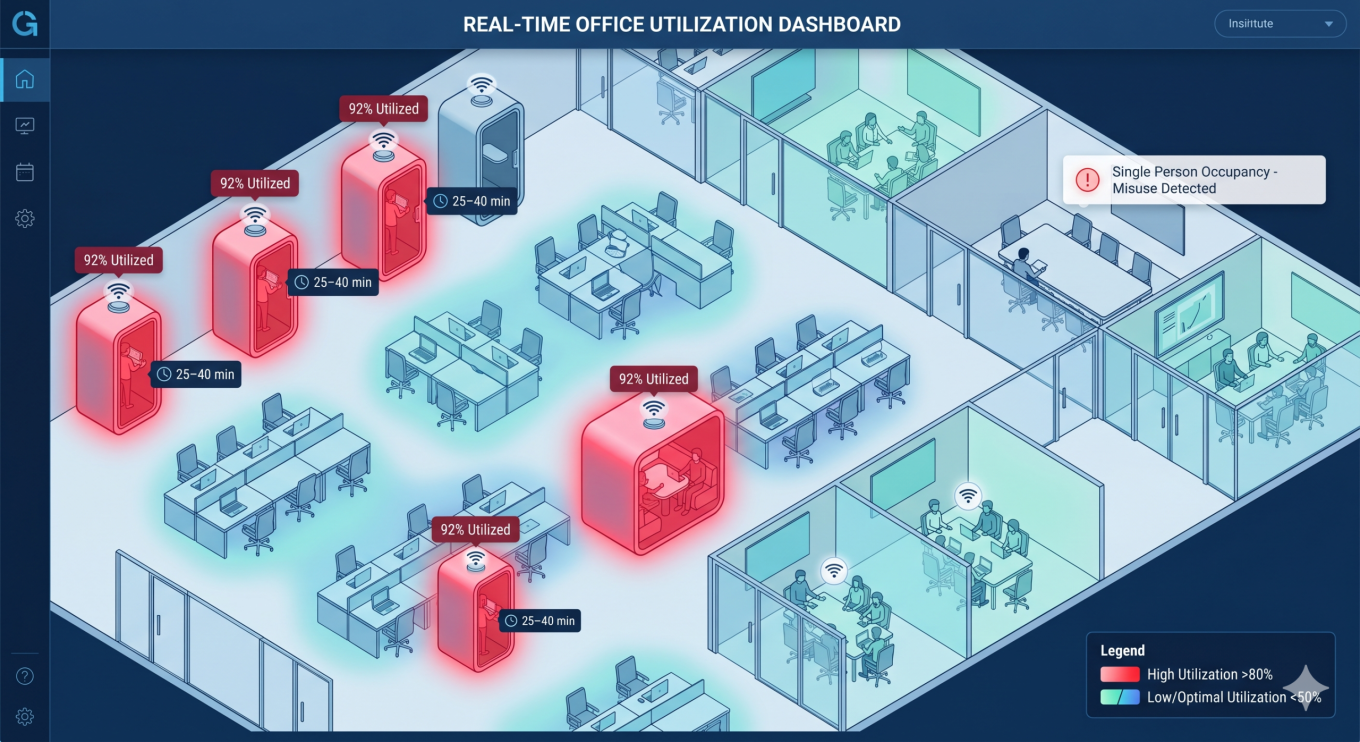
Relying on proxy data like Wi-Fi connections or access badge logs completely fails to measure ad-hoc phone booth or quiet room usage. However, using high-fidelity data from Ceiling Mounted Edge-AI Sensors—which deliver 95% accuracy—reveals several consistent patterns around quiet space usage.
- Phone booths and focus pods run at 80-95% utilization on peak days — far higher than any other space type.
- Average dwell time in quiet spaces is 25-40 minutes, suggesting people use them for focused tasks, not just quick calls.
- When dedicated quiet spaces are full, we see a sharp rise in Single-Person Occupancy (SPO) in larger collaborative spaces. This SPO behavior is essentially an abuse of meeting room resources, consuming valuable group space for individual tasks.
- Quiet space demand peaks between 10am and 3pm, coinciding with prime focus work hours.
These patterns point to a clear conclusion: most offices have approximately half the quiet space capacity their workforce needs. A compounding factor is the rise of online meetings conducted from the office: employees booking small meeting rooms or phone booths for individual video calls. When return-to-office norms mean employees attend the same video calls they used to take from home, demand for enclosed individual spaces increases further — squeezing availability for people who need quiet to do focused work.
Designing Effective Quiet Zones
Not all quiet spaces are equal. The most successful implementations include a variety of enclosure levels: from fully enclosed phone booths for calls, to semi-enclosed focus pods for typing and reading, to designated quiet zones in open areas with behavioral norms.
- Acoustic treatment is essential. Sound masking, absorptive materials, and proper HVAC silencing make the difference between a quiet space that works and one that does not.
- Technology integration matters. Ceiling mounted image-based Occupancy sensors on quiet spaces serve a dual purpose: they show real-time availability (helping people find open pods) and provide utilization data for future planning. Furthermore, leveraging Thread-based, battery-powered sensor architectures makes it incredibly easy to retrofit these specific quiet spaces—like phone booths and pods—without the need for complex drilling or cabling.
- Location is critical. Quiet spaces near high-traffic areas get used more than those in isolated corners. People want quiet, but they also want proximity to their team.
For teams also rethinking their small collaborative spaces, our guide to huddle room design covers the technology, sizing, and sensor strategy for 2–6 person rooms.

Using Occupancy Data to Right-Size
The optimal ratio of quiet spaces to total headcount varies by organization, but occupancy data provides the answer for your specific workplace. By measuring current quiet space utilization, queue times (how long people wait for a pod), and overflow behavior (solo meeting room bookings), you can calculate exactly how many additional quiet spaces to add.
PointGrab sensors provide the desk-level and zone-level data that makes this calculation possible. And because the data is continuous, you can measure the impact of adding quiet spaces and adjust over time.
Your employees want quiet. The data proves it. PointGrab sensors help you measure demand, optimize supply, and create the focus spaces your workplace needs.
Frequently Asked Questions
Why are quiet spaces important in modern offices?
As open-plan offices dominate, quiet spaces provide refuge for focused work, concentration-dependent tasks, and employees needing breaks from collaboration.
How do occupancy sensors help manage quiet zones?
Sensors measure how many people are using the spaces and how often, strictly providing anonymous, aggregate utilization data rather than tracking specific individuals. This helps maintain quiet policies, prevents overcrowding of limited quiet areas, and ensures employee privacy and enterprise trust.
What’s the right ratio of quiet to collaborative space?
Organizations benefit from approximately 30-40% quiet space, though optimal ratios depend on work type and employee preferences.
How do you ensure quiet spaces stay quiet?
Clear policies, occupancy monitoring to prevent overcrowding, user education, and possibly booking systems help maintain quiet space integrity.
How much productivity improvement comes from quiet spaces?
Employees with access to quiet spaces report 20-30% productivity improvements on focus-intensive tasks compared to open environments.
Can quiet spaces be booked in advance?
Booking systems for quiet spaces help prevent overcrowding and guarantee availability for employees needing focused work time.
Related Articles
- Data-Driven Workplace Design: Using Occupancy Intelligence to Create Spaces People Love
- The Complete Guide to Occupancy Sensors for Modern Offices
- Meeting Room Abuse: How the WASH Index Exposes Hidden Space Waste
- How to Design the Best Huddle Room for Your Hybrid Workplace
- Ghost Bookings: Data-Driven Solutions for Meeting Room No-Shows